Tuesday March 22, 2011

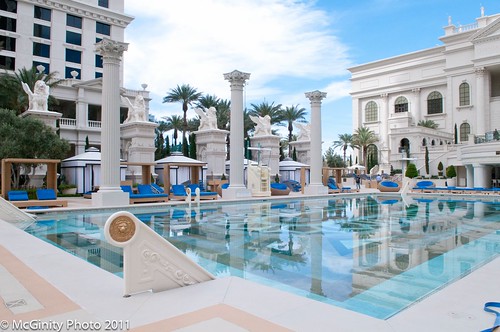
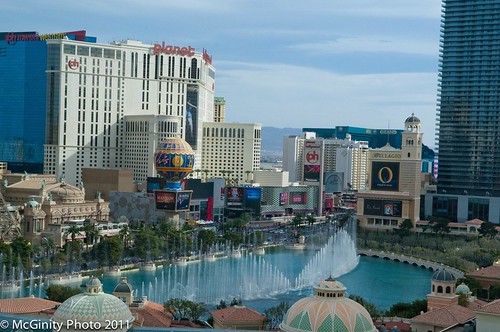
Livin' it up in Vegas at TSSJS 2011 Last Wednesday, Trish and I traveled to Las Vegas for TheServerSide Java Symposium 2011 conference. We had a free room from TechTarget, but opted to upgrade to a suite with a view over the Bellagio Fountains. Trish won a trip to Vegas as a sales award earlier in the year and cleverly exchanged it for cash, so our upgrade was sort of free.
My first talk was on Online Video and my experience at Time Warner Cable. With my former team's iPad app releasing the day before, it was a fun session. The attendance was kind of sparse, but I had some good competition so wasn't surprised.After I finished speaking, we headed to happy hour and met up with some friends that happened to be in town. We had dinner at the Todd English Pub and headed to the Penn & Teller show at the Rio. We closed the night after Trish had a 45-minute roll at the craps table at O'Sheas.
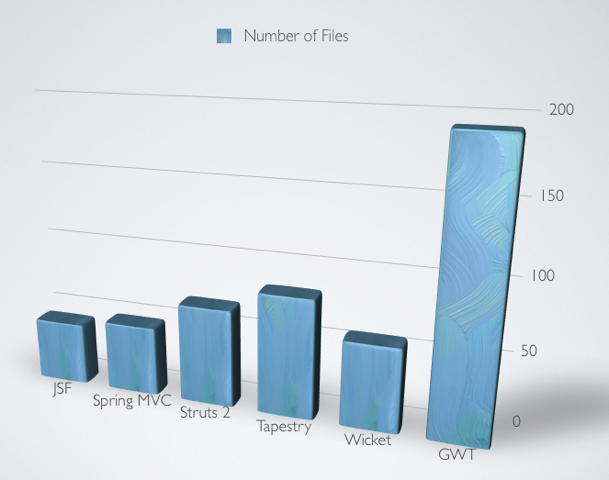
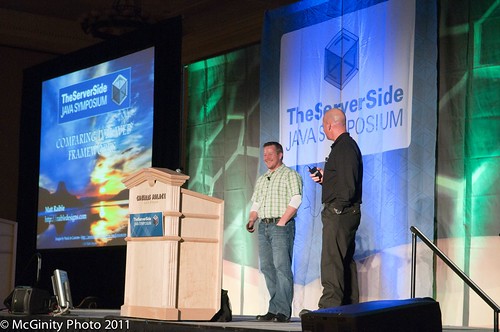
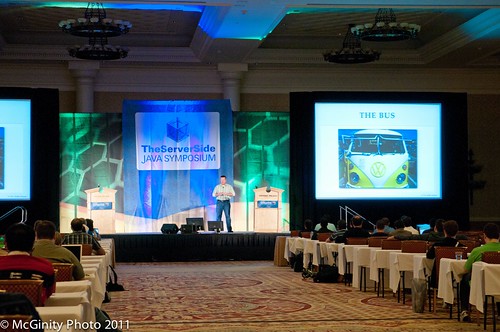
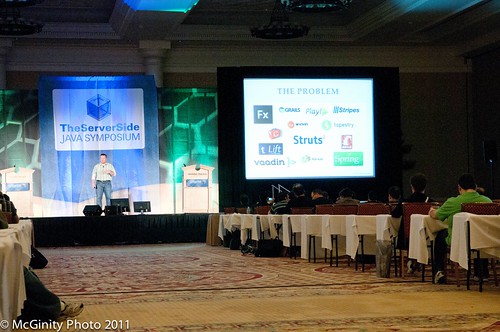
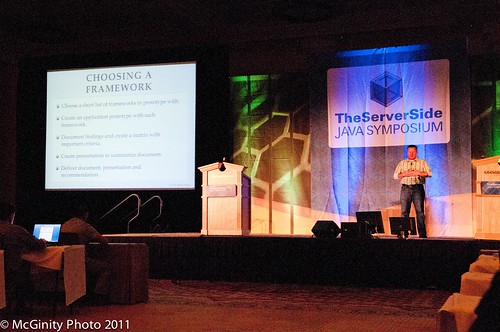
We slept in on Thursday and I gave my Comparing JVM Web Frameworks talk that afternoon. I made sure to mention some other methods to choosing web frameworks: doing performance comparisons like Peter Thomas has done or choosing Lift because one of its developers says it's the best. While Vaadin did sneak into the #5 spot, I made sure and mentioned that Wicket and Tapestry seem to belong there moreso (based on stats, mailing list traffic, etc.).
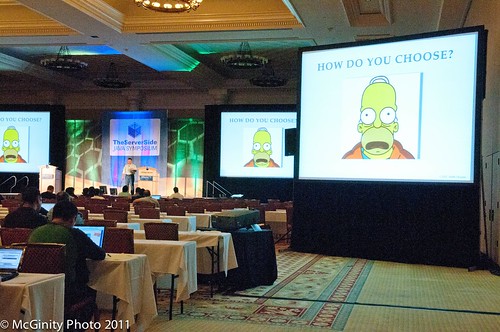
Trish took a bunch of pictures during my talk, which had a great turnout and lots of participation.
That evening, we celebrated St. Patty's Day with some college buddies of mine, ate great sushi at Mizuya and experienced the joys of three card poker. Thanks to TechTarget for inviting me to TSSJS 2011; we had an awesome time. You can find all the pictures we took on Flickr.
P.S. If you can't see the presentations in this post (a.k.a. you don't have Flash), you can view them on on Slideshare or download the PDFs.
Posted in Java
at Mar 22 2011, 09:04:17 AM MDT
Add a Comment
JSR 303 and JVM Web Framework Support Emmanuel Bernard recently sent an email to the JSR 303 Experts Group about the next revision of the Bean Validation JSR (303). Rather than sending the proposed changes privately, he blogged about them. I left a comment with what I'd like to see:
+1 for Client-side validation. I'd love to see an API that web frameworks can hook into to add "required" to their tags for HTML5. Or some service that can be registered so the client can make Ajax requests to an API to see if an object is valid.
Emmanuel replied that most of the necessary API already exists for this, but frameworks have been slow to adopt it.
Hi Matt,
The sad thing is that the API is present on the Bean Validation side but presentation frameworks are slow to adopt it and use it :(
RichFaces 4 now has support for it but I wished more presentation frameworks had worked on the integration. If you can convince a few people or have access to a few people, feel free to send them by me :)
The integration API is described here. Let me know if you think some parts are missing or should be improved. We should definitely do some more buzz around it.
In the interest of generating more buzz around it, I decided to do some research and see what JVM Frameworks support JSR 303. Here's what I've come up with so far (in no particular order):
- RichFaces 4 - Client Side Validation
- Tapestry's JSR 303 - Bean Validation Library
- Wicket JSR-303 Validators
- Configuring a JSR-303 Validator for use by Spring MVC
- GWT Validation
- Vaadin Bean Validation JSR 303 support
- Inline field validation in Scala/Lift using JPA and JSR 303
Struts 2 has an open issue, but doesn't seem to support JSR 303. Since I did a quick-n-dirty google search for most of these, I'm not sure if they support client-side JavaScript or HTML5's required. If you know of other JVM-based web frameworks that support JSR 303, please let me know in the comments.
Posted in Java
at Mar 08 2011, 11:33:24 AM MST
4 Comments
How I Calculated Ratings for My JVM Web Frameworks Comparison When I re-wrote my Comparing JVM Web Frameworks presentation from scratch, I decided to add a matrix that allows you to rate a framework based on 20 different criteria. The reason I did this was because I'd used this method when choosing an Ajax framework for Evite last year. The matrix seemed to work well for selecting the top 5 frameworks, but it also inspired a lot of discussion in the community that my ratings were wrong.
I expected this, as I certainly don't know every framework as well as I'd like. The mistake I made was asking for the community to provide feedback on my ratings without describing how I arrived at them. From Peter Thomas's blog:
What you are doing is adjusting ratings based on who in the community shouts the loudest. I can't help saying that this approach comes across as highly arrogant and condescending, you seem to expect framework developers and proponents to rush over and fawn over you to get better ratings, like waiters in a restaurant trying to impress a food-critic for Michelin stars.
I apologize for giving this impression. It certainly wasn't my intent. By having simple numbers (1.0 == framework does well, 0.5 == framework is OK and 0 == framework not good at criteria) with no rationalization, I can see how the matrix can be interpreted as useless (or to put it bluntly, as something you should wipe your ass with). I don't blame folks for getting angry.
For my Rich Web Experience presentation, I documented why I gave each framework the rating I did. Hopefully this will allow folks to critique my ratings more constructively and I can make the numbers more accurate. You can view this document below or on Google Docs.
In the end, what I was hoping to do with this matrix was to simply highlight a technique for choosing a web framework. Furthermore, I think adding a "weight" to each criteria is important because things like books often aren't as important as REST support. To show how this might be done, I added a second sheet to the matrix and made up some weighting numbers. I'd expect anyone that wants to use this to downloaded the matrix, verify the ratings are accurate for your beliefs and weight the criteria accordingly.
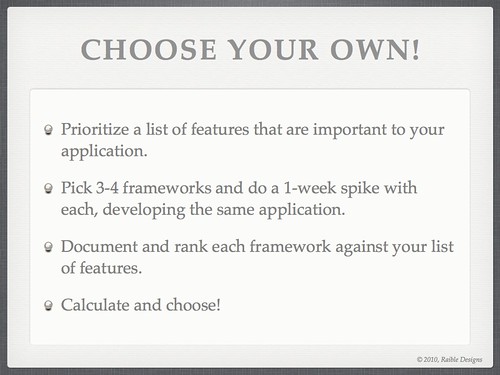
Of course, as I and many others have said, the best way to choose a web framework is to try them yourself. I emphasized this at the end of my presentation with the following two slides.
Posted in Java
at Dec 06 2010, 11:55:18 AM MST
9 Comments
My Comparing JVM Web Frameworks Presentation from Devoxx 2010 This week, I've been having a great time in Antwerp, Belgium at the Devoxx Conference. This morning, I had the pleasure of delivering my Comparing JVM Web Frameworks talk. I thoroughly enjoyed giving this presentation, especially to such a large audience. You can view the presentation below (if you have Flash installed) or download it here.
Unlike previous years, I chose to come up with a spreadsheet matrix that shows why I chose the 5 I did. This spreadsheet and rankings given to each framework are likely to be debated, as I don't know all the frameworks as well as I'd like to. Also, the missing column on this spreadsheet is a "weighting" column where you can prioritize certain criteria like I've done in the past when Comparing Ajax Frameworks. If you believe there are incorrect numbers, please let me know and I'll try to get those fixed before I do this talk again at The Rich Web Experience.
One thing that doesn't come across in this presentation is that I believe anyone can use this matrix, and weightings, to make any of these frameworks come out on top. I also believe web frameworks are like spaghetti sauce in The Ketchup Conundrum. That is, the only way to make more happy spaghetti sauce lovers was to make more types of spaghetti sauce. You can read more about this in my There is no "best" web framework article.
Update: If you disagree with the various ratings I gave to web frameworks in this presentation, please provide your opinions by filling out this survey. Thanks to Sebastien Arbogast for setting this up.
Update: Sebastien has posted his survey results at JVM Web Framework Survey, First Results.
Update 12/6: A video of this presentation is now available on Parleys.com.
P.S. My current gig is ending in mid-December. If you're looking for a UI Architect with a passion for open source frameworks, please let me know.
Posted in Java
at Nov 18 2010, 05:23:10 AM MST
37 Comments
My Presentations from The Irish Software Show 2010 This week I've been enjoying Dublin, Ireland thanks to the 2nd Annual Irish Software Show. On Wednesday night, I spoke about The Future of Web Frameworks and participated in a panel with Grails, Rails, ASP.NET MVC and Seaside developers. It was a fun night with lots of lively discussion. Below is my presentation from this event.
This morning, I delivered my Comparing Kick-Ass Web Frameworks talk. This presentation contains updated statistics for various metrics comparing Rails vs. Grails and Flex vs. GWT.
Thanks to all who attended my talks this week!
P.S. I believe audio was recorded on Wednesday night, but I'm unsure how it turned out. I'm pretty sure no recordings were done on this morning's session.
Posted in Java
at Jun 10 2010, 07:11:35 AM MDT
9 Comments
My TSSJS 2010 Presentations and Summary This afternoon, I delivered my last talk at TSSJS 2010 on The Future of Web Frameworks. It's true that I made some bold statements, but please remember that this is my personal opinion, based on my experience. For the most part, I've been involved in super high-traffic websites for the last few years and this has influenced my opinion on web frameworks. Just because I don't recommend your favorite framework doesn't mean it won't work for you. In fact, many of the best web applications today were built without an open source (or commercial) web framework. In the end, it's not as much about the web framework you're using as it is about hiring smart people. Below is my slide deck from this talk.
Yesterday, I did a GWT vs. Flex Smackdown with James Ward. While there wasn't as much trash talking as I'd hoped, I enjoyed delivering it and disputing the greatness of Flex. Below is the presentation that James and I delivered.
The show itself was great this year. It had more attendees than I've seen in a long time. There were a lot of really interesting sessions and and an often humorous Twitter back-channel. I attended quite a few talks and jotted down my notes from several of them. Please see the links below if you're interested in the sessions I attended. You can view all of the presentations from TSSJS 2010 on SlideShare.
- What's Happening in the Java World?
- Software Quality: The Quest for the Holy Grail?
- The Cloud Computing Continuum with Bob McWhirter
- Highly Interactive Software with Java and Flex
- C++, Java and .NET: Lessons Learned from the Internet Age
- Developing Rich Web Service APIs with Java
- What's New in Spring 3.0
Thanks to everyone who came to Vegas and to TheServerSide for an excellent conference.
Posted in Java
at Mar 19 2010, 05:29:08 PM MDT
8 Comments
Comparing Kick-Ass Web Frameworks at The Rich Web Experience Yesterday, I delivered my Comparing Kick-Ass Web Frameworks talk at the Rich Web Experience in Orlando, Florida. Below are the slides I used:
Although it's difficult to convey a presentation in a slide deck, I can offer you my conclusion: there is no "best" web framework. I believe web frameworks are like spaghetti sauce in that everyone has different tastes and having so many choices is necessary to satisfy everyone. You can read more about the plural nature of perfection in Malcolm Gladwell's The Ketchup Conundrum (a written version of What we can learn from spaghetti sauce). Even though there is no "best" web framework, I believe GWT, Flex, Rails and Grails are frameworks that every web developer should try. They really do make it fun to develop web applications.
You can find the slides for my other RWE talk at Building SOFEA Applications with GWT and Grails.
Kudos to Jay Zimmerman for putting on a great show in Orlando this year. I had a great time talking with folks and learning in the sessions I attended. I particularly enjoyed bringing my parents and kids and staying at such a nice resort. Disney World (Magic Kingdom) and Universal Studios was very enjoyable due to the short lines. Also, the weather was perfect - especially considering the freezing cold in Denver this week.
Posted in Java
at Dec 04 2009, 08:16:48 AM MST
3 Comments
GWT OAuth and LinkedIn APIs
When I worked at LinkedIn last year, I received a lot of inquiries from friends and developers about LinkedIn's APIs. After a while, I started sending the following canned response:
For API access to build LinkedIn features into your application, fill
out the following form:
http://www.linkedin.com/static?key=developers_apis
For requests to build an application, go to:
http://www.linkedin.com/static?key=developers_opensocial
I talked with the API team and they did say they look at every request that's sent via these forms. They don't respond to all of them b/c they know that many people would be angry if they told them "no", so they'd rather not have that headache.
Yesterday, I was pumped to see that they've finally decided to open up their API to Developers.
Starting today, developers worldwide can integrate LinkedIn into their business applications and Web sites. Developer.linkedin.com is now live and open for business.
First of all, congratulations to the API team on finally making this happen! I know it's no small feat. Secondly, it's great to see them using Jive SBS for their API documentation and developer community. My current client uses this to facilitate development and I love how it integrates a wiki, JIRA, FishEye, Crucible and Bamboo into one central jumping off point.
I've always been a fan of LinkedIn, ever since I joined way back in May 2003. However, I've longed for a way to access my data. LinkedIn Widgets are nice, but there's something to be said for the full power of an API. Last night, I sat down for a couple hours and enhanced my Implementing OAuth with GWT example to support LinkedIn's API.
I'm happy to report my experiment was a success and you can download GWT OAuth 1.2 or view it online. For now, I'm simply authenticating with OAuth and accessing the Profile API.
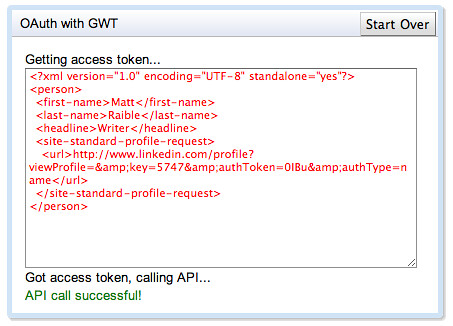
In the process, I learned a couple things:
- LinkedIn's OAuth implementation returns an oauth_verifier parameter after authenticating, whereas Google and Twitter do not. This parameter needs to be included when calling the Access token path.
- The Profile API example I implemented gets the current user's profile with http://api.linkedin.com/v1/people/~. This returns a "light" version of your profile. To get a more detailed version, you need to use Field Selectors. For example: http://api.linkedin.com/v1/people/~:(id,first-name,last-name,picture-url,headline,summary,positions,educations)
- LinkedIn's API only supports passing OAuth parameters in a header, rather than query parameters. To make this work, I modified my ProxyServlet to convert query parameters to an "Authorization" header at the end of the setProxyRequestHeaders() method.
// For LinkedIn's OAuth API, convert request parameters to an AuthorizationHeader
if (httpServletRequest.getRequestURL().toString().contains("linkedin-api")) {
String[] parameters = httpServletRequest.getQueryString().split("&");
StringBuilder sb = new StringBuilder("OAuth realm=\"http://api.linkedin.com/\",");
for (int i = 0; i < parameters.length; i++) {
sb.append(parameters[i]);
if (i < parameters.length - 1) {
sb.append(",");
}
}
Header authorization = new Header("Authorization", sb.toString());
httpMethodProxyRequest.setRequestHeader(authorization);
}
You might recall that my previous example had issues authenticating with Google, but worked well with Twitter. LinkedIn's authentication seems to work flawlessly. This leads me to believe that Twitter and LinkedIn have a much more mature OAuth implementation than Google.
Related OAuth News: Apache Roller 5 will be shipping with OAuth support. See Dave Johnson's What's New in Roller 5 presentation for more information.
Update December 6, 2009: I modified the gwt-oauth project to use GWT 1.7.1 and changed to the Maven GWT Plugin from Codehaus. Download GWT OAuth 1.3 or view it online.
Posted in The Web
at Nov 24 2009, 03:46:05 PM MST
7 Comments
Building SOFEA Applications with GWT and Grails
Last night, I spoke at the Denver Java User Group meeting. The consulting panel with Matthew, Tim and Jim
a lot of fun and I enjoyed delivering my Building SOFEA Applications with GWT and Grails presentation for the first time. The talk was mostly a story about how we enhanced Evite.com with GWT and Grails and what we did to make both frameworks scale. I don't believe the presentation reflects the story format that well, but it's not about the presentation, it's about the delivery of it.
If you'd like to hear the story about this successful SOFEA implementation at a high-volume site, I'd recommend attending the Rich Web Experience next month. If you attended last night's meeting and have any feedback on how this talk can be improved, I'd love to hear it.
Posted in Java
at Nov 12 2009, 09:30:09 AM MST
11 Comments
Consulting, SOFEA, Grails and GWT at next week's Denver JUG Next Wednesday, I'll be at Denver's JUG meeting to talk about Independent Consulting and Building SOFEA Applications with Grails and GWT. The first talk will be a a panel discussion among local independent consultants, including James Goodwill, Matthew McCullough, Tim Berglund and myself.
This session explores the trials and tribulations of an independent consultant. How do you find contracts? Should you setup an LLC, an S-Corp or just be a sole proprietorship? What about health insurance and benefits? Are recruiters helpful or hurtful? Learn lots of tips and tricks to get your dream job and your ideal lifestyle.
The Grails and GWT talk is a preview of a talk I'll be doing at the Rich Web Experience in December. Below is a rewrite of the abstract in first-person.
Earlier this year, I participated in a major enhancement of a high-traffic well-known internet site. The company wanted us to quickly re-architect their site and use a modern Ajax framework to do it with. An Ajax Framework evaluation was done to help the team choose the best framework for their skillset. The application was built with a SOFEA architecture using GWT on the frontend and Grails/REST on the backend.
This talk will cover how Bryan Noll, Scott Nicholls, James Goodwill and I came to choose GWT and Grails, as well as stumbling blocks we encountered along the way. In addition, we'll explore many topics such as raw GWT vs. GXT/SmartGWT, the Maven GWT Plugin, modularizing your code, multiple EntryPoints, MVP, integration testing and JSON parsing with Overlay Types.
If you're in Denver next Wednesday night (November 11th), you should stop by the Denver JUG meeting. It'll be a fun night and there's sure to be a few beers afterward.
Posted in Java
at Nov 05 2009, 10:52:37 PM MST
5 Comments
Search This Site
Recent Entries
- Secure JSON Services with Play Scala and SecureSocial
- My What's New in Spring 3.1 Presentation
- Twitter's Open Source Summit: Bootstrap 2.0 Edition
- Refreshing AppFuse's UI with Twitter Bootstrap
- 2011 - A Year in Review
- Upgrading AppFuse to Spring Security 3.1 and Spring 3.1
- What have I been working on at Taleo?
- Our Engaging Trip to Paris and Antwerp
- My HTML5 with Play Scala, CoffeeScript and Jade Presentation from Devoxx 2011
- Deploying Java and Play Framework Apps to the Cloud with James Ward